

Cuiabá is not a well-known city outside of Brazil. Inside the country, however, it is famous for a particular reason: its heat. The drenching heat keeps people off the streets for most of the year. At 1 pm, no matter the season, you would hardly see anyone out. Afternoons in Cuiabá turn the city into a ghost town in plain daylight. Only the crooked yet blossoming Ipês are to be seen, flaring it with a tinge of life.
Historically, it is the culmination of a settlement, like many other Brazilian sites, born out of exploitation. The municipality was founded by a bandeirante, a gold-seeking colonial mercenary, usually hired to capture and kill enslaved people who rebelled. The region showed great potential, but the gold found there, which had served as the excuse for the city’s inauguration, was exhausted in less than a decade. In a sense, Cuiabá was already born as a land of broken promises.
—
Meningitis is a disease I heard little about up until that moment. It is a name I knew belonged to an ailment but, in my experience, the name was mostly confined to textbooks and news bits. The extent of the disease’s virulence can hardly be conveyed by its sterile scientific taxonomy. These denominations are a kind expression of civility. They work in euphemizing an experience too horrific to be put into words. In a sense, my age is already advanced enough for me to have witnessed a few tragedies hidden by faraway names—my grandmother victimized by tetanus a couple of years ago, and now this poor little girl. I never saw any of their faces after they died—neither the girl’s, at mere 4 years old, nor my grandmother’s at 86.
—
When I arrived in Cuiabá, the heat didn’t disappoint—a wave of hot air fell onto my body as soon as I set foot outside the plane. The visit was much anticipated. I was coming back to Brazil for the first time since moving abroad together with my partner, a European national, on her first visit to my homeland.
The airport itself looked consumed by the heat and dust. My parents held me tight with the habitual warmth, but I knew immediately there was tension. As is typical in Brazilian families, there was little structure to our visit, and I soon realized that my uncle and aunt, who were hosting us all, were juggling several emotional demands, with something far more severe at the forefront.
On the ride back to their apartment, they let slip, amidst the welcoming amenities, that they might have visitors. A couple of friends who lived in the countryside brought their little girl for a medical appointment, and she was immediately hospitalized. They might need to spend the night, my uncle said, but it was nothing serious. I tried to translate the conversational acrobatics for my partner, who suffered amid the palpable yet ungraspable weight in the car.
We were hosted with snacks and drinks. We sat around a table in a small apartment, telling jokes and sharing trivial stories. The AC blasted its cooling breeze nonstop, fighting the hot air pressing against the windows. My uncle’s phone would eventually ring. He would retreat to one of the bedrooms, only to come back a few minutes later with a theatrical smile on his face.
Then, after one of these calls, he arrived back without a smile. Even within that tiny apartment, somehow he managed to whisper through the room, saying it without saying, that something bad had happened. The girl’s condition deteriorated, and it took another long phone call for him to announce she died.
—
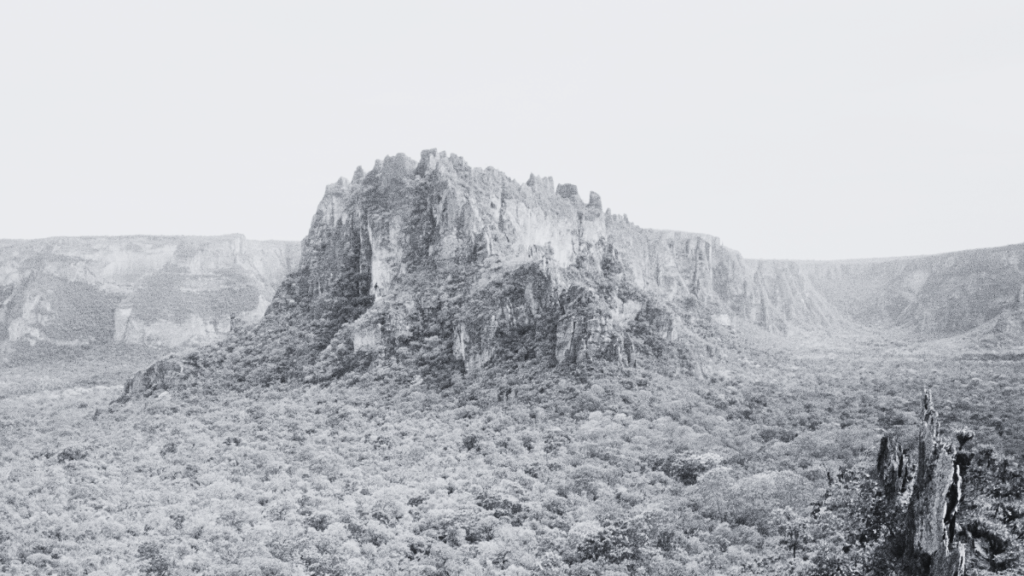
My partner and I spent the following weekend in the Chapada dos Guimarães, in a guesthouse reservation kindly gifted by my uncle. The Chapada is one of the many national parks in central Brazil that represent one of the most common yet least appreciated ecosystems of the country—the savannas, held by massive rock plateaus and extending over thousands of acres. We took a day to do a guided tour with a local named Pablo. He had a boyish, almost flamboyant demeanor, and showed a deep love for the region. Despite claiming to be uneducated, he gave us lengthy and enthusiastic explanations across several strands of knowledge—botanical, historical, folklorical—that came together in that place.
One particularly fascinating thread touched on the geological composition of the immense rock plateaus in the area, some of which reach up to 800 meters in height. I asked if climbing was a common sport in the Chapada, as my brother is a passionate climber. It was impossible to climb there, Pablo said. Despite their enormity and visual impact, the plateaus were composed almost entirely of sandstone, a clastic sedimentary rock that gave the walls a reddish shade and a flaky texture. Pablo demonstrated it in practice, piercing a piece of rock from the walls and cracking it with the pressure of his grip. He invited us to do the same. Standing high atop a colossal mass of rock, we could extract its pieces by hand and crush them with our fists, as if we were somehow suspended in empty clouds in the sky, impossible to surmount.
—
Three people arrived in the apartment—the two parents and the grandmother. The parents, in particular, carried in their faces the only true depiction of grief I believe I have ever witnessed in my entire life. Up until that moment, I had never seen what true sadness looks like. We were nine people crammed into the living room of a 45-square-meter apartment, with the AC struggling to keep the temperature cool.
There were some attempts at conversation, always circumventing the event itself. I realized there that, despite my partner not speaking any Portuguese, we were all equally illiterate in that room. No one had the language required to communicate anything of substantial meaning. We all lacked the wisdom and vocabulary to deal with a tragedy so violent and arbitrary. Words were babbled, but a deep, mournful silence appeared louder after each utterance. That is, until the mother addressed me directly, with a question that I will likely carry with me for the rest of my days.
It was after dinner. She spent a long bit completely silent, as the husband attempted to fill the room with pleasantry. Then, she looked at me suddenly, as if reminded of something important. She asked: “I understand you have been abroad studying Theology. Perhaps you can answer my question: what happens after we die? Where is my baby girl now?”
I felt my heart pierced by a bayonet. Butterflies flew away from my stomach, and I was left empty inside out. I did give her an answer. But it is telling that I can’t recall virtually anything I said.
What she meant by “Theology” was my degree in Religious Studies. It arrived by mail, written in Latin. I remember staring at those foreign words, understanding nothing of what they said. I looked at that mother that day feeling equally dumbfounded. I wish what I had studied would have equipped me to serve exactly in that moment. The prestigious school I went to, however, didn’t provide me with adequate tools. I had a faint notion of what Aquinas’ eschatology had to say about the afterlife. Would it help appease that mother’s tears?
The question hung in the air a while before the subject switched completely. I kept giving the mother occasional glances afterward, trying to catch in her any sign of relief. It was my impression that she became slightly more talkative. Realizing soon enough how little my presence meant, I retreated into habitual quietness. We all went to sleep in separate rooms—the family stayed in the guest room, previously reserved for my partner and me. As for the two of us, we slept in the living room, tightly together on the small sofa. It took me a long time to fall asleep.
When I was on the plane back to the USA, ready to continue pursuing the said degree, the occasion kept ringing in my mind. Somehow I found myself at the center of this big and clumsy thing we call “religion.” Whatever it means, I thought, it still serves a purpose—a purpose which I, despite holding proper credentials, couldn’t honor. Nonetheless, I wanted to. I still do. Despite my obvious failures, I sighed, realizing, if only for a while, that whatever I was then looking for in this often indifferent world perhaps has real meaning.
Sometimes we choose to seek shelters that are easy to build and find. But things that are easy to build are also easy to break. Not always that which looks hard and strong, which shines with a blinding hue, provides the best material for protection. Immense rockwalls are built on stones that we can break with our fists. These flaky, blood-soaked stones are still here, and will continue to be when nothing else remains.
The puzzle still lingers in my heart—but now less concerned with the afterlife and more with this life. It touches the sense of responsibility towards those close to me. And it also kindles a sense of gratitude for finding the rock shelter I did. Even if I do sometimes wonder why it looks coarse and brittle, and hold myself under suspicion frequently, I have to remind myself again and again—it is because it is old.
—
On the last day of our stay, we weren’t able to say goodbye to my uncle. He arrived after we fell asleep, and hadn’t woken up when we left early in the morning. He spent late hours at his new job, as the head manager of a recently established gold mine on the outskirts of Cuiabá. It’s all under the guise of the law, he always said. A few days before, he took a small glass container out of his pocket and dropped out some raw gold nuggets for us to see. Untreated gold looks very different from the shining precious stone we see in the jewelry shops. Holding an opaque, dry-plum-shaped nugget between his fingers, he said with a broad smile: “This is worth ten grand.”
Leaving the apartment, I saw his dirt-clenched boots lying on their side by the door, as if they were themselves exhausted from overwork. They were studded with the reddish mud typical of Mato Grosso, clinging to his shoes like ticks, spreading dark, crimson dust wherever he passed. Less than a year later, he told me he had left that job. Too demanding, he said, especially for his age. Somehow, this news brought me great relief.