

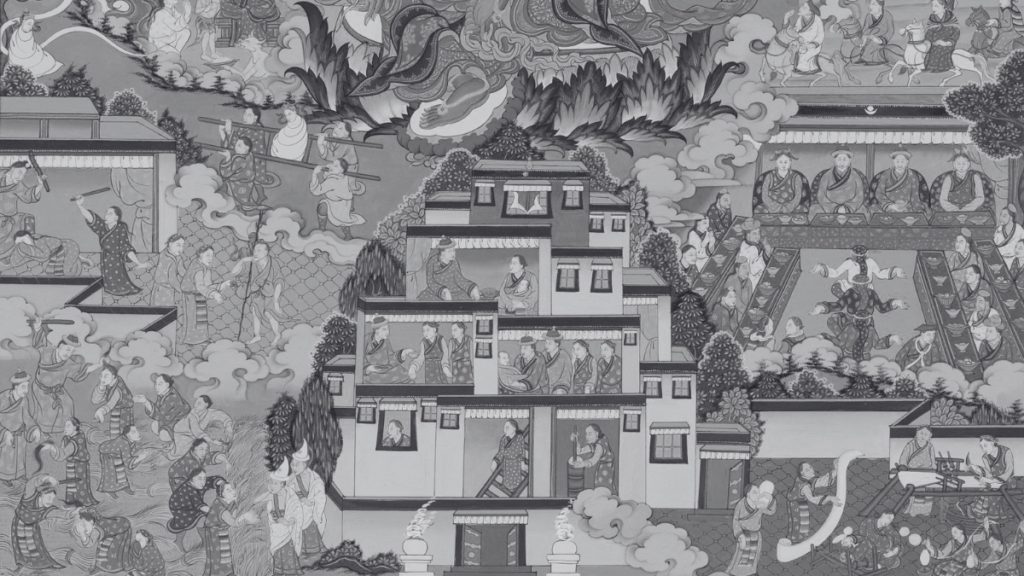
Poor girl, they all said. Her body spread across the mountain range with vultures hovering over it. She didn’t deserve this horrible fate.
She was born in the King’s Apex to a well-to-do family. Ambition, however, is the seed of one’s own demise. They were not content with what they had and wanted more. When the opportunity came to sell the little girl to a powerful man, they didn’t hesitate. He was known as the Mountain Roar because of his loud voice and aggressive demeanor. When the Roar caught a glimpse of the girl’s beautiful braids, fluttering in the wind like sāla tree branches, he couldn’t contain himself. This beautiful tree, so many times in history, has been painted in blood. In the Tale of Heike, written around the same time in eastern islands far away, we read opening lines that parallel the tragedy in the mountains: sharasōju no hana no iro jōshahissui no kotowari wo arawasu—the color of the sāla flowers reveals the reality that the prosperous must decline.
At first, the girl accepted her destiny. It’s a truth that cuts through the mountains more than anywhere else—the virtue of forbearance. The mountains never fight back. They are impervious to the whims of the wind and the snow. She decided to withdraw all resistance. When captured like a hostage to live with the Roar’s son, she accepted her destiny in a resolute but dignified silence.
Her kindness won over all those around her. She became a source of joy and appreciation, especially for the worn-down servants, routinely humiliated by the Roar’s violent tantrums. His son, the Suitor, was completely entranced by the beauty, gentleness, and wisdom of that seemingly innocent farm girl. The union, albeit forced, brought them a healthy child—a boy with an easy smile and a loving nature. He would often be seen clutching his mother’s robe, comfortable only under her warm protection.
There was one secret, however, hidden deep down the girl’s heart. From her very early days, she nurtured a single-pointed desire. She had no interest in either the farm life or the royal life. What she truly wanted was to disappear in the caves, throw away her clothes, and become naked. She wanted to vanish from the world she was given, and to live with the dogs. There was no dignity to be found for women in that world—perhaps not in any world. The only reasonable decision seemed to abandon it. Instead of home, she craved homelessness.
The tragedy amplifies as the source of the girl’s disgrace centers around another woman. Always called the Aunt, she was the older sister of the Suitor, the son of the Roar. When the treasury keys were handed to the girl—an acknowledgment that she became the most reliable person in the family—the Aunt could not bear her jealousy. Or so the story goes.
The Aunt’s vindictive rage pours out on the girl on two different occasions—both sprouting from acts of kindness. In the first, the girl is moved by two strangers begging alms amidst an abundant crop. She offers them all the grain they have collected. The Aunt cannot accept it. She violently attacks the girl during an argument. To her brother, the Aunt tells a different story—that the girl has attacked her instead. The Suitor believes his sister’s version.
The second incident involves a peculiar character. He is a magician who does tricks with a monkey. The magician sings a song in the girl’s window. The girl is captivated. The singing figure alludes to a reality the girl craves, of vagrancy and dispossession. She invites him upstairs to her private chamber. The girl wishes to gratify the man financially for his act, without a speck of malice in her thoughts. The Aunt sees it differently. She accuses the girl of infidelity, projecting her own neurosis onto the girl. This time the girl reacts. She attempts to undo the lying, but the Aunt won’t accept it. The Suitor resolves the matter, siding with the Aunt once again. In a fit of rage, he beats the girl to near death and sets out to give away their child.
That night, the girl cries alone in her room. She is weak and hurt. Life is no longer worth holding onto. She whispers goodbye in the empty room and decides to leave this world behind. In the morning, the Suitor finds her no longer breathing.
Grief and guilt set in. The Suitor and his family organize a funeral procession in honor of the girl. Her body is enveloped in white silk and placed on a bier, sitting down. The extended ceremonial parade takes her mummified body to the top of the King’s Apex mountain, where the girl spent her early days. The corpse is unwrapped and offered to the vultures. The hungry birds stare from above at their freshly served feast.
The Lord of Death, however, is not happy to meet the girl. Knowing it was not the right time for their meeting, He decides to send her back. She was assigned the task of fulfilling her craving—abandoning ordinary life and retreating into the mountains. Achieving such, the Lord of Death thinks, is how this extraordinary girl will be of most benefit to the world.
Her dead body awakes in a blaze of fire. The mountains tremble, and those who hurt her before feel an unexplainable prick in their hearts while they lie in bed at night. The girl roams in the dark with the wolves. She is finally where she was supposed to be—as a freewheeling vagrant in the mountains.
The tale of the reborn woman spreads across the county. Some people say she was empowered by the Lord of Death himself to enact revenge on those who wronged her. Some claim to have seen her ghastly presence flying around the valley, together with the vultures. The rumors spread further until the Mountain Roar family hears about them and starts to wonder, in fear, whether the girl will show up to haunt them. Their guilty conscience pops up in long nightmares filled with fantasies of violence and retribution.
In an ironic twist, the girl finds company with those who were the seed of her early ruin—the beggars and the magician. They reveal themselves to be the kind of wanderer the girl always wanted to follow. Dispossessed people, invisible on the surface of the world, but immensely knowledgeable of its depths. Together, they settle with other vagrants, people who refused the ways of the corrupt world they were brought into. They choose to live a life of quiet contemplation, far away from the concerns of worldly existence.
The almighty Roar, naturally, couldn’t tolerate it. When news arrived that there was a settlement of tramps in the immediate vicinity, and, worse, that the undead girl was among them, he reunited his troops and marched, ready to shed blood.
The campaign was quick and efficient. The group of vagrants had little to defend themselves. The blades of the Roar’s army cut through their bodies like butter, spreading pools of blood across the rocky valleys, throughout which severed limbs rolled down the slopes. The soldiers pressed through, searching for the girl. She went into hiding in a cave at the top of the mountain, where the magician was teaching his monkey some tricks. What am I to do? She asked. When the man snapped his fingers, the monkey would roll a somersault. What are we to do? It’s all an illusion, anyway. Smokes and mirrors.
The girl stepped out of the cave and revealed herself. She had then surrendered herself to total freedom, flowing in the trench between the living and dying. She sings an incantation that brings all those who were killed back to life. Loose limbs sew themselves back onto corpses, and the blood evaporates from the steeps, forming a dense, reddish fog that the undead breathe as if it were oxygen. The Mountain Roar, the Aunt, and the Suitor watch it all stupefied. They fall to their knees in tears, acknowledging their wrongdoings, while the army runs away in complete dread.
The girl, however, won’t punish her foes. The story ends with her taking them by hand and guiding them through the right path—starting with her strayed son. She liberates them from their afflictions, and they achieve ultimate realization. Everyone is finally released from their binding ignorance.
—
The tale of Namsa Woebum is one of the many Tibetan folk stories believed to have roots in real people. The supposedly real character lived between the eleventh and twelfth centuries, in the region of Gyantse. It is still fondly cherished in Tibetan culture as one of the Eight Tibetan Operas—a series of traditional performances that remain popular today both in China and among Tibetans abroad. Tibetan operas are known by the name lhamo, or sometimes, ache lhamo, both literally meaning “female goddess.” These dramas have a distinctly feminine character, and the tale of Namsa Woebum is one of the most representative—and beloved—among them.
I wonder: what flesh-and-bone truths could be concealed by these mythological accounts? The tale of Namsa Woebum—a name that roughly translates to “One Hundred Thousand Lights Shining From the Earth”—is as old as history, and yet remains insistently modern. A woman is victimized by a horrific relationship with a man and finds no way out. She is brutalized, beaten, humiliated—and found guilty for doing so by all those around her. In a world that gives her no way out, the ultimate release is death itself.
Did this real person, probably a young girl who had hardly hit puberty, trick those around them—like a magician with his monkey—to believe she was dead? What if the girl conceived of a scheme, a ruse, to fake her own death as the only solution to escape her misery? I can see her being carried away on a bier, closing her eyes tightly and holding her breath after practicing yogic techniques for hours and hours to reduce her vital signs. In the darkness of the mortuary cloth, she feigns a smile, knowing no one sees it.
In the deep, quiet night of Gyantse, her corpse rises alone on the top of the county’s highest mountain. She is finally free, undressed, naked to the world, yet no longer bearing the body that condemned her at birth. She looks up to the sky. Staring back at her are the stars. She takes a long, relieved breath in and out, acknowledging, perhaps for the first time, that she is alive.
In Buddhist jargon, we speak of four degrees of spiritual realization. First, we have the stream-enterers (srotāpanna), second, the once-returners (sakṛdāgāmin), third, the non-returners (anāgāmin), and, finally, the venerable ones (arhat). The stream is said to be the path to liberation taught by the Buddha. It alludes to a flow that carries one from affliction to liberation. But the flow itself is often barraged by our habitual tendencies of attachment to an existence of suffering. In an interesting choice of words, the “path” is a stream—something you let yourself flow into, instead of having to struggle to cross through. It is by holding tightly that we often return, even if against our best interests, to our tormentors.
In the original tale of Namsa Woebum, she comes back from the dead to teach the Dharma to the living. In a literary sense, she is like a sakṛdāgāmin—a once-returner. She gives her abusers a last chance of redemption—an operatic demand for a happily-ever-after ending to all involved. It is a steep slope uphill to arrive at the point of a venerable; one who can leave one’s fetters behind once and for all.
In real life, however, I like to imagine her as an anāgāmin—a non-returner. She never gives them a chance to cross the stream. Instead, she leaves all behind, never again to return. Roaming alone in the mountains, she is occasionally seen by nomads who start spreading the story that she came back from the dead. The story becomes legend, and the legend becomes opera.
To her foes, the rumors suggest the figure of an undead demon who haunts them in sleepless nights. To the other hundreds of thousands of lights shining from earth, her bright ghost keeps beaming in the imagination, suggesting the ever-present yet evasive possibility of finding freedom.