

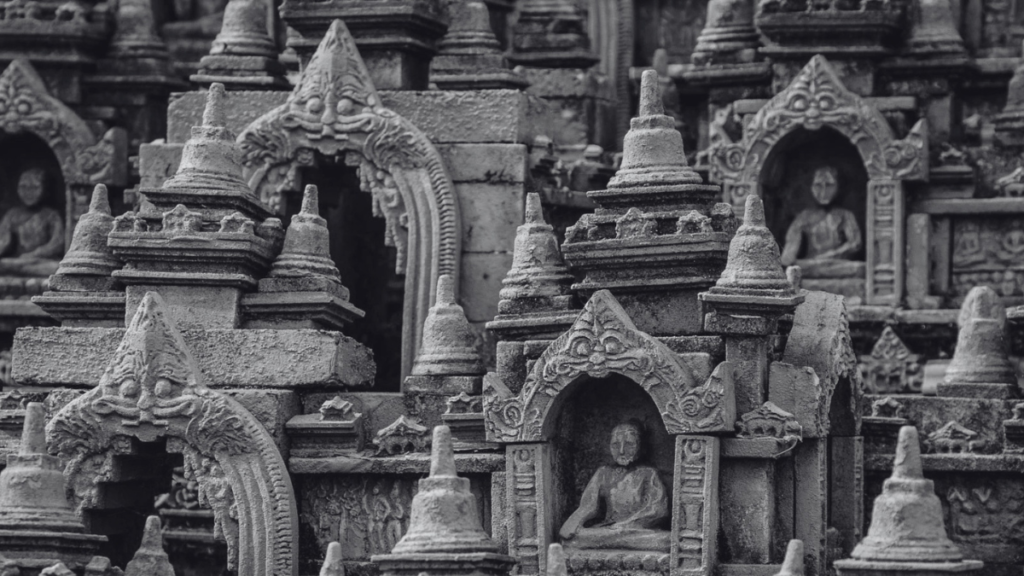
To those who have spent some time with Buddhist primary philosophical sources, thinking by means of lists, catalogs, and enumerations comes as no surprise. The most popular philosophical assertion in Buddhism worldwide is a clear example—the four noble truths. These four have countless subdivisions within them—three sufferings, five aggregates, three poisons, eight paths; the list goes on.
These, however, are just the tip of the iceberg. The classical typology of Buddhist canonical knowledge is divided into three—the Tripiṭaka. The systematic prong out of this trident is the Abhidharma. Across its vast textual corpus, the Abhidharma essentially typifies the entire realm of experience. As per Andrew Olendzki’s compilation of the Abhidhamma literature—the branch of the Abhidharma compiled in the Pali language—the texts speak of 28 physical phenomena co-arising with 52 mental factors, manifesting as 89 types of consciousness, which unfold in a series of 17 mind moments, governed by 24 types of causal relation. Needless to say, this is merely one of the many possible Abhidharma typologies, amidst yet other canonical typologies.
Studies on these lists have often attempted to identify the reasoning and motivation behind them. The obvious explanation is their application as mnemonics. In cultures where written language hasn’t fully established itself, lists facilitate memorizing large chunks of information and working through them as a unified whole. This reasoning sounds convincing but insufficient. The earlier written records of Buddhist thought abound in lists and catalogs, but this tendency didn’t diminish as the centuries advanced and as Buddhism developed into a written culture across Asia.
Furthermore, cultures that rely predominantly on oral transmission of knowledge often resort to other techniques, such as poetic narratives built in rhyme and versified rhythm. The idea that a matrix of endless lists could be implemented for purely pragmatic reasons—that is, being easy to remember—seems to rest on thin ice. Virtually every Buddhist culture has developed some sort of catalogical approach to knowledge, in which the classification of experience seems actually to correspond to its explanation rather than to facilitate it. The question of why this is the case remains intriguing.
The essayesque nature of these pieces allows for speculations that would not fit into serious academic papers. In that vein, the matter of fascination with lists and cataloging in Buddhist thought deserves imaginative treatment.
From an epistemological perspective, the question of what knowledge even is goes hand in hand with the question of how it is to be represented. In that sense, the approach to knowledge normalized in our culture is what we could call “processual”—knowledge is something that can be expressed in terms of processes. These processes are often highly formalized—as logically concatenated arguments in philosophy or numerical operations in math. Knowledge of our world is mediated by mastery of those formulas—by understanding the processes that take place in it, we come to understand the world itself. This epistemology is so widespread that it seems to be the only possible way to produce knowledge. I suspect early Buddhist thinkers would disagree.
In the sūtra collections—another prong of the Tripiṭaka trident—we find the closest thing to narrative literature in the Buddhist canon. These narratives, however, are also saturated with lists. A particularly good example is the Gaṇḍavyūhasūtra—read here from its Tibetan Derge edition. The narrative centers on a character named Sudhana in his meetings with several kalyāṇamitras—virtuous friends. He meets fifty-three figures—deities and humans, children and adults, lay and monastic, men and women. Across these meetings, he is bestowed with a series of aphorisms—often lengthy and repetitive lists of qualities, circumstances, characteristics, phenomena, etc.—and referred to the next virtuous friend.
In one of the longest sections of the sūtra, in which Sudhana meets with the Buddha of the next eon, Maitreya, the reader is inundated by an overwhelming account of enumerations of several aspects of the experience of meeting Maitreya. One might be tempted to believe that the lists themselves matter due to the depth of their content—but the things being listed vary widely in nature. Earlier in this section, we read about the empowerments that Sudhana acquires when entering Maitreya’s palace. The paragraph states he is empowered with thirteen kinds of equality (tib. mnyam nyid)—like the equality of reaching the limits of existences or the equality of the nonconceptual true nature—thirteen kinds of wisdom (tib. ye shes)—like the wisdom of birthlessness or the wisdom of non-dependence—and thirteen insights into the nature of phenomena (tib. chos nyid)—like the insight into the nature of phenomena being like an echo or being like a dream. On the other hand, when merely describing the abode of Maitreya, the text proceeds to describe a fifty-item list always followed by the construction “adorned by countless” so-and-so (tib. grangs med pa’i rgyan gyis brgyan pa). Some of the items are windows, mirrors, and pillars. The largest Buddhist temple in the world, Borobudur in Indonesia, has a good chunk of its walls illustrating the Gaṇḍavyūhasūtra in a particularly maximalist fashion, almost as if emulating the text’s literary devices in its architecture.
The repeated usage of these formulas forces us, as readers, to reconsider what we are to expect from the act of reading itself. It raises broader questions about the purpose and approach one was expected to take when engaging with these texts. Processual thinking—expressed in terms of equations, arguments, and, to an extent, storytelling—shapes our reasoning in a horizontal line, where our thoughts are always taken from point A to point B. Whenever we open a text of whatever nature, this “line of reason” is often what we expect to find. The alternative catalogical textual approach adopted by Buddhist thinkers seems to recognize, in its grid-like structure, a fundamental element of the message it wants to convey. Instead of being taken from one point to another, the texts break through this pattern, fragmenting our thinking in all directions. The knowledge it produces doesn’t come from a straight line of reasoning, but from how it disassembles the whole of our imagination into atomic parts. It is important, however, to distinguish this approach from a mere aesthetic preference for psychedelic imagery.
One of the earliest philosophical schools of Buddhist thought is the Sarvāstivāda, which can be roughly translated as “the all-existing” school. Despite being regarded as outranked by later literature and established traditions—particularly those grouped under the vast Mahāyāna umbrella—their influence remained perennial in Abhidharma theories. Their distinguishing philosophical assertion was the claim that all dharmas—the constituents of our experience—exist across all times. This statement served as a holding glue between two seemingly incongruent statements that populate the Buddhist intellectual tradition. One—that phenomena are impermanent and cease to be; two—that causal relationships are established in our world, allowing for the continuity of karma and rebirth across cyclic existence. The contradiction is evident: what explains that things are causally linked to each other in such a way that phenomena that are no longer can produce effects right now? Or, putting it roughly, if identity is impermanent and a person has no soul, what then is reborn?
To the Sarvāstivāda, this incongruency is explained by the perpetuation of the fundamental elements of experience—the dharmas—across time: past, present, and future. The ultimate consequence—later rejected by other Buddhist schools—is that the dharmas are, then, existent. It is only when they are assembled together that we are faced with the “identity” illusion that makes the mind perceive the appearance of identity in a person (skt. pudgala). The whole—the pudgala—is a mere illusion, whereas the parts—the dharmas—are real. This assessment matters when we return to appreciating the epistemic tools used by Buddhist thinkers not only to develop a philosophical idea but also to present it in its full breadth. The Abhidharma system, in that sense, is a sort of show-don’t-tell philosophical mechanism that breaks the whole of the unreal experience—where our mistaken perception habitually dwells—into the interdependent network of its components.
My focus on the reality of the dharmas—as per the Sarvāstivādins—matters here because of the frequent association between this sort of Buddhist imagery, such as the Gaṇḍavyūhasūtra’s literary devices and the Borobudur architecture, with otherworldly phenomena, such as hallucinogenic experiences, supernatural phantasmagoria, or, to some even bolder minds, extraterrestrial beings. The foundation of this imagery is precisely an attempt to delve deeper into this world—to represent what is real rather than what is unreal. This chronic rendition of Buddhist thought as something belonging to the “other-world” has important implications that I hope to explore in future essays. But in sum, it continually divorces Buddhist thought from real-life problems, turning it into a mystical curio reserved for an esoteric elite. Nothing could serve Buddhist culture less than hermeneutics of this kind.
What Buddhist catalogical thinking does is to provide a direct parallelism between the episteme and the logos—in other words, it approximates the substance of knowledge to its representation. The representation of knowledge is itself turned into a network of substantial atoms that accentuates the emptiness of the whole that contains it. The proposed imaginative treatment of this thinking thus incurs a paradox—a much-appreciated tool in Buddhist epistemology. By displaying experience in this maximalist fashion, this distinctly Buddhist technique highlights the very impossibility of phenomena existing as they appear, shifting our minds from the empty nature of the whole appearance to its constituent parts.